Description
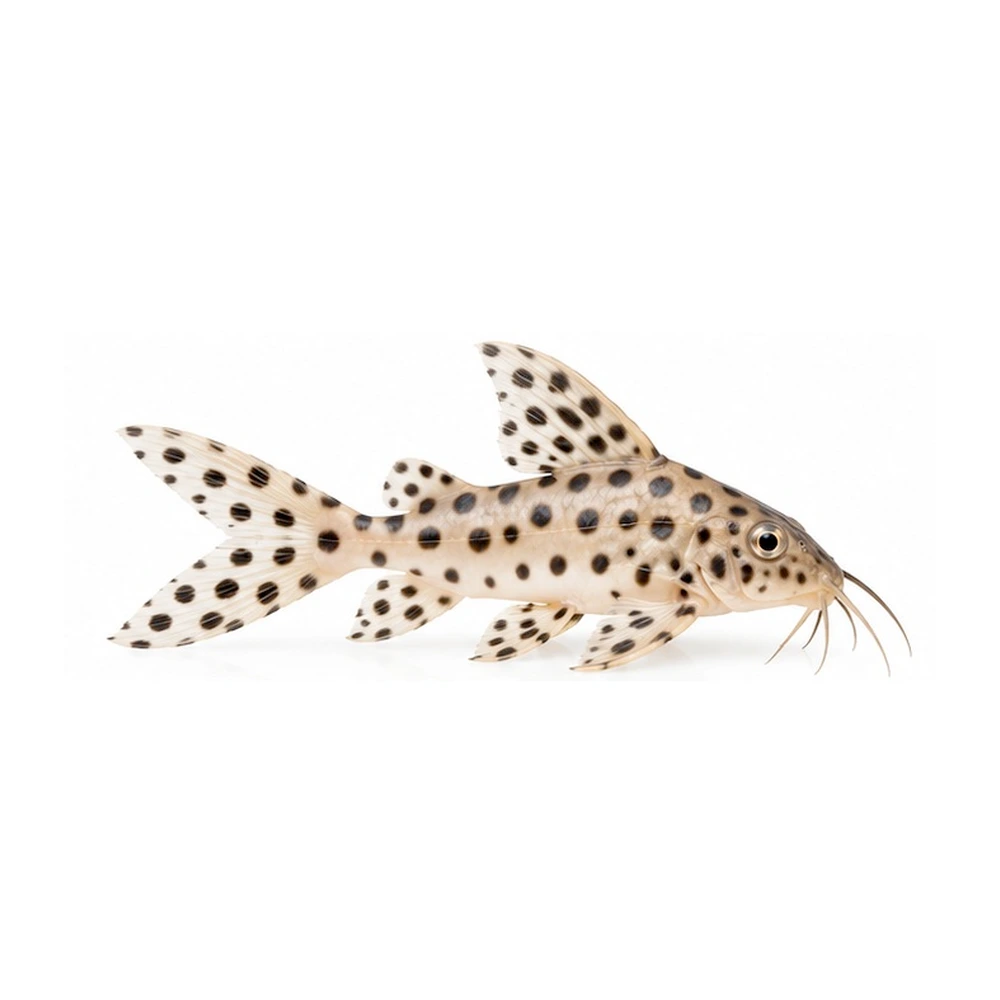
Quick answer: cuckoo synodontis (Synodontis multipunctatus) are Tanganyikan catfish sold at 5 to 7.5 cm. They are famous for brood parasitism, where the female lays eggs among a cichlid spawn and the host fish raises the fry.
That behaviour is the reason the fish has a following. It is also a genuine husbandry fact rather than marketing: the species spawns in the wild by mixing its eggs into the clutches of mouthbrooding cichlids, and it will do the same in an aquarium when the conditions line up.
Identification
Pale body with dark spots, large eyes, three pairs of barbels and a high dorsal fin. The body is deeper than a featherfin and the spotting is finer. At 5 to 7.5 cm the fish is young; adults reach around 15 cm.
Water parameters
Lake Tanganyika conditions suit them best: 24 to 27 degrees Celsius, pH 7.8 to 8.8 and hard water with a high mineral content. They are active swimmers and do better in groups than alone, which is unusual for synodontis.
Behaviour and tank mates
Peaceful but busy. They swim in open water as well as along the bottom, and they handle themselves well with cichlids. A Tanganyikan community with rockwork, shell beds and open sand suits them. Avoid soft, acidic water, which is the opposite of what they need.
Diet
Omnivorous. Sinking pellets, frozen food and meaty pieces, plus vegetable matter. They feed actively and are not shy about competing at meal time.
Grading and packing
Fish are graded at 5 to 7.5 cm, fasted before dispatch and packed in oxygen. They travel well when the water in the bag matches the hard, alkaline conditions they came from, so we pack with that in mind rather than using generic water.
Ordering
Send the quantity, size and destination. We confirm availability, the water parameters the batch was held in and the delivery terms.
Breeding behaviour in the aquarium
Brood parasitism is not a party trick, but it does happen in captivity when cuckoo synodontis are kept with mouthbrooding cichlids. The female scatters eggs during a host spawn, the cichlid collects them with her own, and the catfish fry hatch first and eat the cichlid eggs. Keepers who want to see it need a species tank rather than a general community, plus patience.
Frequently asked questions
What does brood parasitic mean?
The female lays eggs among a mouthbrooding cichlid’s spawn, and the host fish raises the synodontis fry.
What water do they need?
Hard, alkaline water at pH 7.8 to 8.8, matching Lake Tanganyika.
Can they live in a normal community tank?
Only if the water is hard and alkaline. Soft acidic water is not suitable.
Reviews
There are no reviews yet.